
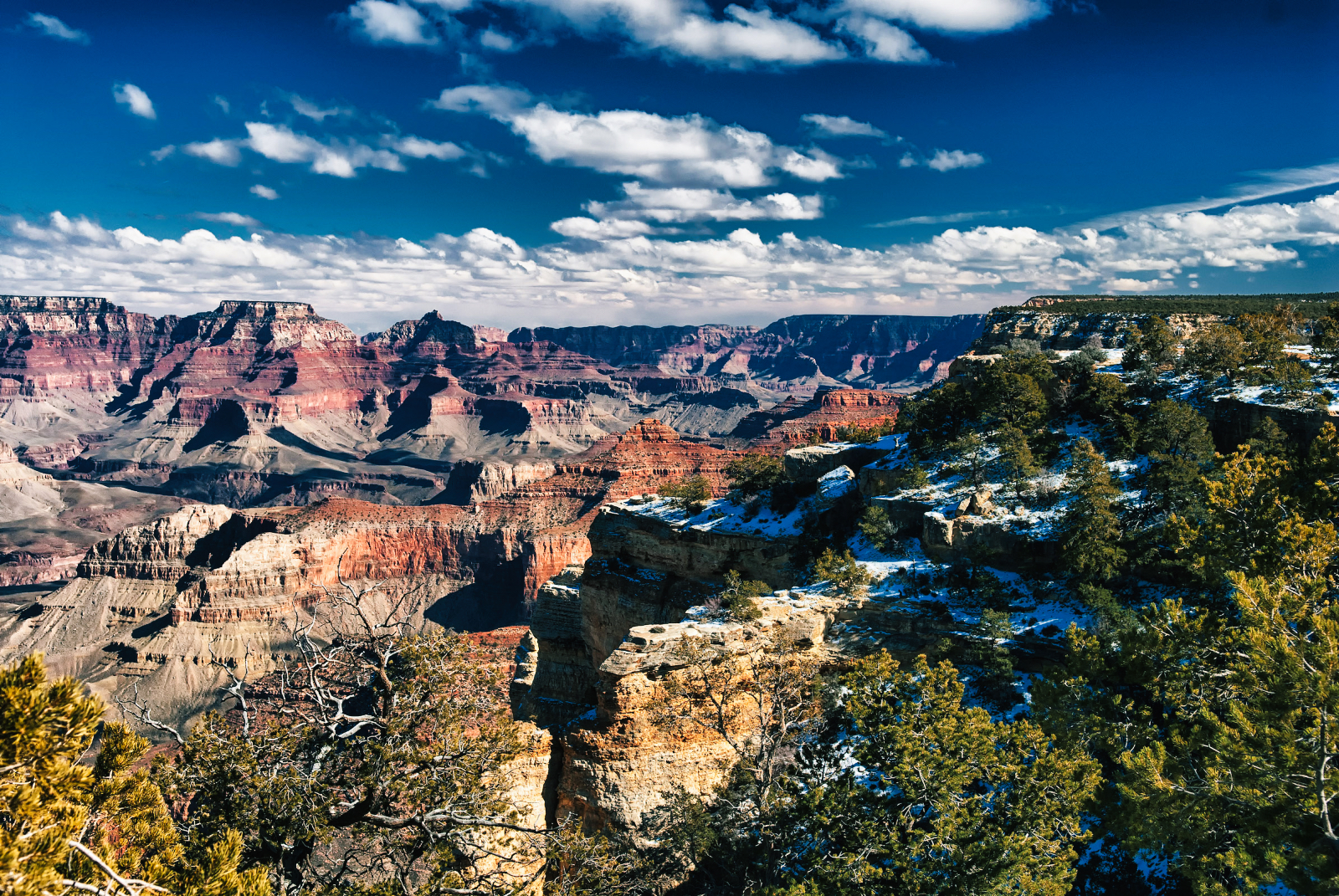
I’ve posted a couple of Grand Canyon pictures which elicited a positive reaction. So I think I should post a more extensive selection of images from that winter visit to the canyon. It was quite cold, and perhaps because of that the air was unusually clear. All of these images were photographed from the North Rim.
Wikipedia says that the Colorado River began flowing in it’s present course 5-6 Billion years ago. The River began carving the canyon over 2 Billion years ago. The truly incredible thing about the Grand Canyon – and what amazed me on this, my first visit to the Canyon – is that 2 Billion years of Earth’s history can be seen in the different colored layers of rock.

It’s no secret that I like trees. These images of trees on the canyon rim or in the canyon presented really interesting perspectives on canyon views. The center pic is the one previously posted. (Click image for fullsize view.)


This has been one of my most favorite tree pictures. The darker blobs on the canyon are shadows of the clouds, not the tree. In monochrome, which is also very nice, that’s hard to tell. The tree frames the canyon view behind it. It’s like the canyon is saying to the tree, “Hey, you shouldn’t get all the attention! I’m right behind you!” Right below the tree is a sheer dropoff, so the tree is mostly jutting out over the canyon.


On the left, we see the Colorado River. This was photographed near the eastern end of the Canyon. The river is carving a path through what I think are younger rocks. The river exhibits the snake-like appearance that rivers often tend to develop over time.
On the right is another, more distant, view of the river. The river here has begun to erode deeper (or further back) in time. (Again, click for larger view.)


On the left, a unique feature of the south canyon, the seated figure, watching over the canyon day and night. On the right, another tree growing on a canyon wall. There are some unusual rock formations that I didn’t see anywhere else. The most significant aspect of this photograph (at least when I was there) is the sheer anxiety-inducing dropoff. (Click…)


As the day wore on, clouds were building in. I could have edited out the clouds as the rest of the view is pretty amazing, but I’ve chosen to do very little or no editing of the mages.

Finally, the clouds began to increase significantly and snow began moving in from the northeast. The view here is from Navajo Point. (This is the other image previously posted. I’ve cleaned it up and sharpened it some.
A note on cameras. I shot these Grand Canyon images with an old Nikon (D200) and a tripod. Extraordinary sharpness and clarity (the NIkon lenses). But it was all very heavy (and as noted above, it was very cold.) It was shortly after this trip that I sold all the Nikon gear and switched to Fuji, a choice I have not regretted. However, that’s not the point of this comment. The camera and the associated gear were heavy and cumbersome, and I was freezing. So eventually I left it all in the car and went hiking the rim without cameras. When I was probably too far to go back, I came upon some great photo opportunities, including some fascinating flowers growing out of the rocks in the dead of winter! Moral: Never leave the camera behind!
Leave a ReplyCancel reply