
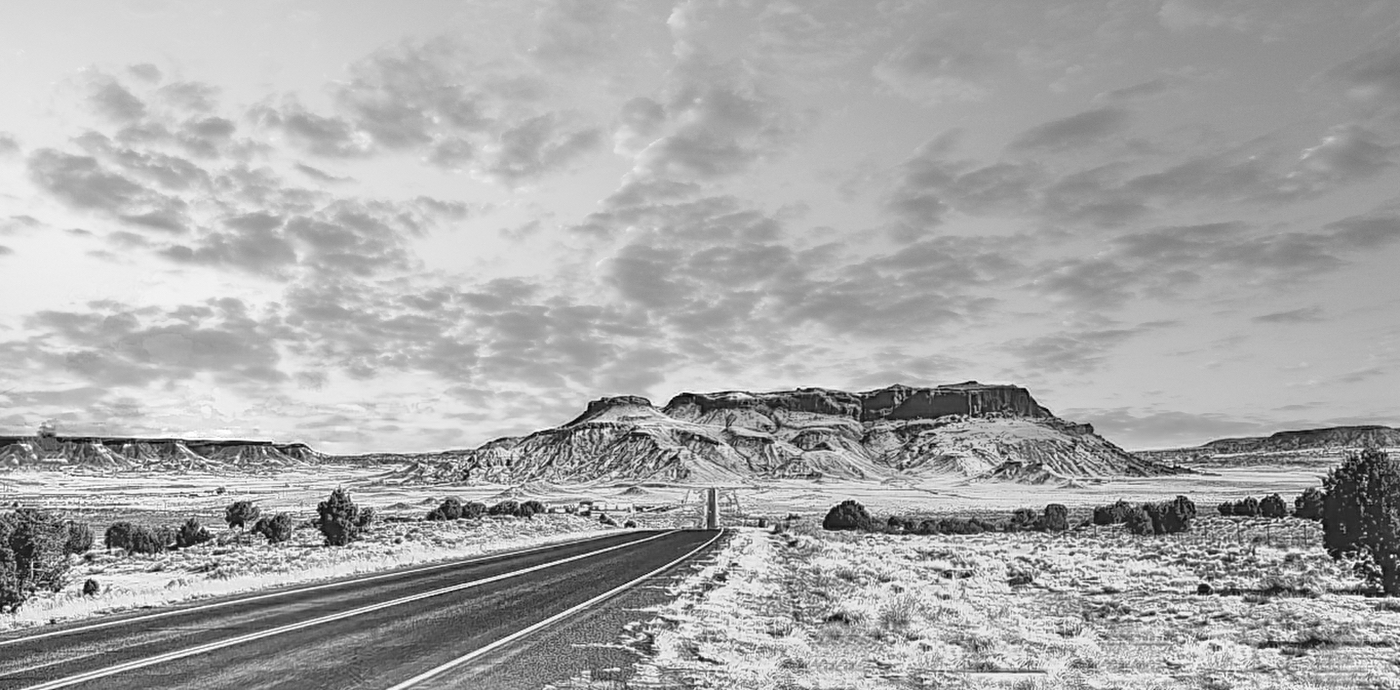

The image above (and left) depicts the part of Arizona that belongs to the Hopi Reservation. The (very straight) road in the image comes up from Winslow, Arizona, probably known by most from the Eagles song. The US government inexplicably set the Hopi reservation right in the middle of the Navajo reservation, an action that has resulted in tension and longstanding land disputes. The Hopi Lands are characterized by many mesas, or buttes as they are known locally, with many Hopi villages atop the mesas..
Unlike the Navajo, who are outgoing and have turned much of their activities in the arts and crafts into commercial enterprises, the Hopi are, if not unwelcoming, more private. The Hopi are an agricultural and traditional society.
The Hopi have one of the oldest continuous cultures in North America, with a history spanning thousands of years. Their ancestors, the Ancient Puebloans, established villages on the mesas of northeastern Arizona and developed into an agricultural society. After successfully revolting against Spanish rule in 1680, the Hopi further reinforced their traditional ways and retreated to fortified settlements.
The Hopi Reservation occupies about 1.5 million acres in the high desert. The climate’s limited precipitation, arriving via summer monsoons and winter snow, has shaped Hopi agricultural practices, leading to the development of sophisticated “dry-farming” techniques that rely on rainfall and runoff. Hopi land, known as Hopitutskwa, is considered sacred, and the people see themselves as its caretakers.

This image was selected by the State of Arizona for the cover of an informational pamphlet about the Hopi.
Hopi culture is known for its peaceful way of life, deep religious beliefs, and strong traditions. Society is organized around a matrilineal clan system, with children belonging to their mother’s clan. A complex religion centered on a cycle of year-long ceremonies seeks to maintain balance in the world and bring rain.


Leave a ReplyCancel reply