
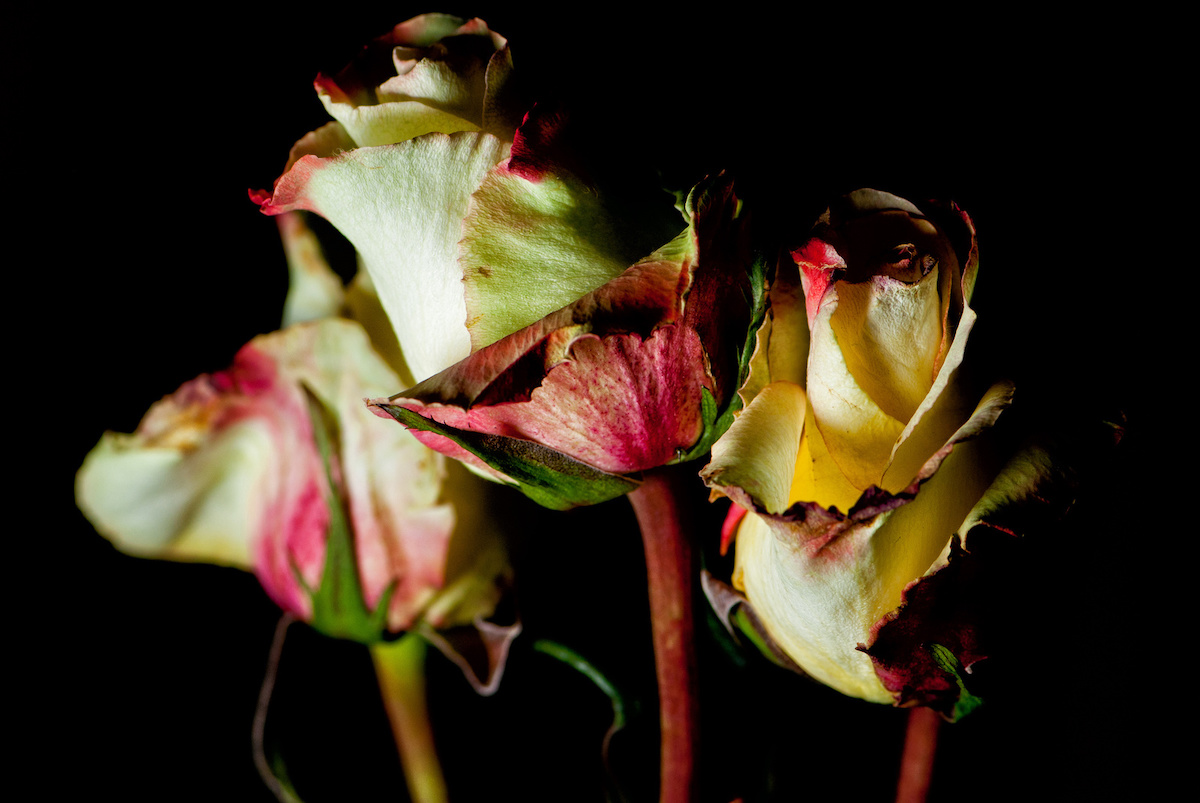
After a moderately long absence from the Lens Artists Challenges, I’m jumping in here to reply to Tina’s challenge this week: Wabi-Sabi. I was not familiar with this concept until now. My AI reports:
Wabi-sabi (侘寂) is a foundational Japanese worldview and aestghetic centered on finding beauty in imperfection, transience, and incompleteness. Rather than seeking flawlessness, it encourages an appreciation for the natural lifecycle of growth, decay, and the unique history embedded in physical objects.

Let’s start with the featured image above and to left, “Three Roses.” Three roses that don’t exhibit the classical form associated with roses. Maybe they would open further, but at this point, there’s a beauty in the somewhat scraggly, imperfect appearance of the roses.

Simplicity, order with disorder, there is beauty in this stack of wood.

There’s little order in these images of water in a stream rushing over grasses and other vegetation. But, again, we find beauty – a kind of simplicity – in the images.

The calla lily, encountered in the woods, conveys a beauty in its simplicity.


Leaves change colors in autumn, and for a short while before winter comes we are treated with a glorious display.

The trees are mirrored in the flowing river. Change the angle of view, the image disappears. The river changes it’s flow pattern, or the sunlight changes, the image disappears.

This image of moss and some leaves, sticks, and other detritus is perhaps the best example of Wabi-Sabi here. Come the next snow, or just a hard rain, or the next spring, this particular image will change or disappear. Yet, right now, there is a certain beauty in the disorder.
Those are my choices for this week’s challenge. Thanks to Tina for this week’s theme. Be sure to visit her website. Next week’s challenge will be issued by Patti.


Leave a Reply