
“New Images” is a weekly feature posted every Wednesday exploring AI imaging and new
editing techniques incorporating new ideas about fine art images.
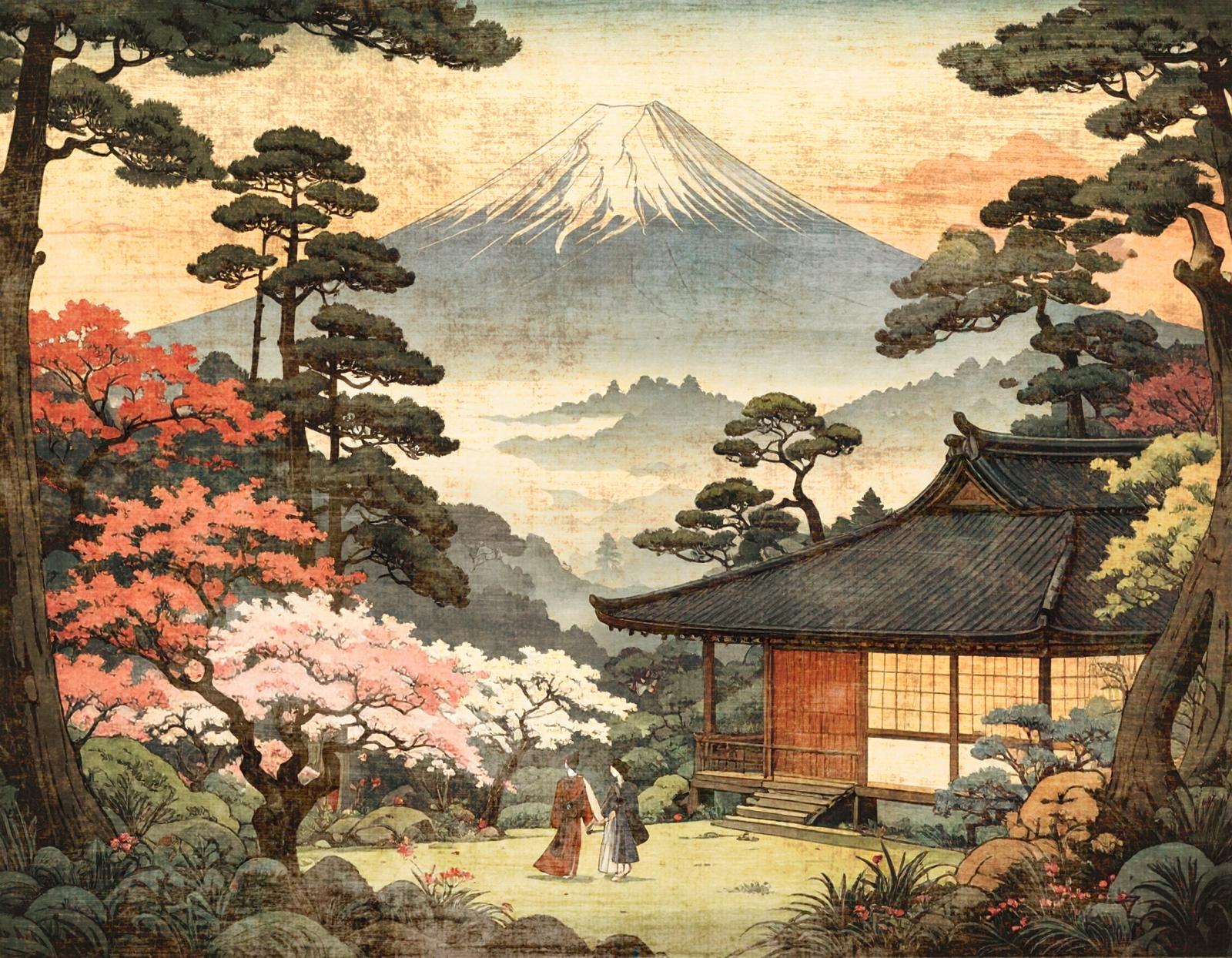
This week’s post features ukiyo-e, an art form developed in Japan in the early 17th Century during the Edo period, depicting scenes of everyday life in Japan. Initially done on hand-carved wood blocks, Ukiyo-e later embraced painting. Ukiyo means activities of people; e means picture. Ukiyo-e included pictures of nature and landscapes. The genre is characterized by minimalistic designs, usually created through simple lines and gently flowing curves and then finished with bold colors. This contrast between simplistic, focused design and vibrant, dramatic color helped to bring the flat, two-dimensional design to life. The form evolved to include subjects like beautiful women, kabuki actors, historical and mythical scenes, and, later, detailed landscapes by artists like Hokusai and Hiroshige.

(Click the image at left to view larger image with full-screen option.)
Method and techniques. As applied in this image. The “base image” is generated by AI. (In this case, I used Adobe Firefly.) The creative element in this is visualizing the desired image and creating the prompt that will direct the AI. Usually, several iterations are necessary, with edits to the prompt, and this image was no exception.
The final prompt for this image was:
ukiyo-e wood block print in the style of Hokusai of a romantic couple in a garden surrounded by flowering trees with mount fuji in the distance with soft morning light
Then, some traditional touch-ups may be needed (color, light, etc). Some things in the image may need to be removed or added. I used each of these steps for this image. Finally, I added a texture overlay as a layer to enhance the woodblock appearance.
Here is another image in this style. (Click the image for a larger view and full-screen option.)

And, finally, a landscape… (Click image for a larger view and full-size option.)


More about Ukiyo-e
In my images above, I tried to emulate the style of Katsushika Hokusai, one of the two most famous artists who worked with Ukiyo-e images. The image at left is his most famous work, “The Great Wave Off Kanagawa.” Wikipedia tells us:
The print is Hokusai’s best-known work and the first in his series Thirty-six Views of Mount Fuji, in which the use of Prussian Blue revolutionised Japanese prints. The composition of The Great Wave is a synthesis of traditional Japanese prints and use of graphical perspective developed in Europe, and earned him immediate success in Japan and later in Europe, where Hokusai’s art inspired works by the Impressionists.

Here is another work, which I selected at random, from the same series of Hokusai. This image shjows a country scene and is thus more similar to my images above. (Click either image for a large view with a full-screen option.)
[Both prints are in the Metropolitan Museum of Art. Images in the public domain.]Note that Wikipedia includes a complete catalog of all thirty-six images, including the images.

The Ukiyo-e artist who rivals Hokusai in fame is Utagawa Hiroshige. This is one of his works that I like, included in Hiroshige’s series, “One Hundred Famous Views of Edo.” This work bears the title, “Sumida River, the Wood of the Water god.”
[Print is in the Los Angeles County Museum of Art. Image in the Public Domain.](You can also click this image for a larger view and a full-screen option.)
That’s it for this week. I hope you have enjoyed this excursion into Ukiyo-e. Watch next week for a new exploration in New Images.


Leave a ReplyCancel reply