This week Egidio challenges us to think of what’s wild. We could come up with many different approaches to this theme. Here goes mine.
Most southern (Arizona) mountains were volcanic in origin. In the shadow of the San Francisco Peaks outside Flagstaff, there’s the Sunset Crater, the result of a violet eruption during the 11th century. The volcano split the land along a line over 6 miles in length, and lava poured profusely. That’s pretty wild. Nine-hundred square miles were incinerated and covered with lava and ash. So my first image is of a portion of the lava field from the eruption.

It was winter, same trip as for the Grand Canyon. The lava field is at the lower right. The image doesn’t do justice to the frozen lava that I had to hike over to get to this point.
Few things are as wild as Easy Rider, the 1969 film starring Dennis Hopper, Peter Fonda, and Jack Nicholson. Here is a wonderful (original) trailer for the film. I think anything with Steppenwolf’s “Born to be Wild” qualifies for this week’s wild theme. The following image is of the road running from south of Flagstaff through the Waputki National Monument in Arizona. It’s a location in the film.

In the film, Hopper and Fonda (on motorcycles) pick up a hitchhiker at the Sunset Volcano Crater and ride south along this road. They stop at the Wupatki ruins where they camp out. The movie films them sharing pot at the ruins.

I find the Wupatki ruins fascinating for another reason. Wupatki was a site as early as the 11th Century BCE, when it was settled by the early Pueblo People. Hopi, Navajo and Zuni people arrived after the Sunset Crater eruption. They prospered at Wupatki for two hundred years. It’s remarkable that they developed unique systems of irrigation, as there is virtually no water in the area. They saved rainwater. There are many ruins scattered through the area, but the area has returned to the wild.
Traveling to the east and south, we arrive at the Badlands, south of the Painted Desert and the Petrified Forest.

According to Wikipedia, “A badlands (also badland) is a type of dry terrain where softer sedimentary rocks and clay-rich soils have been extensively eroded by wind and water.” The name is apt. Early Lakota Indians called such lands “Makhóšiča“, literally bad land, while French trappers called it “les mauvaises terres à traverser” – “the bad lands to cross”. The Spanish called it tierra baldía(“waste land”).” The idea of the badlands bring to mind T. S. Eliot’s “The Wasteland. To me, the badlands represent the epitome of wildness.
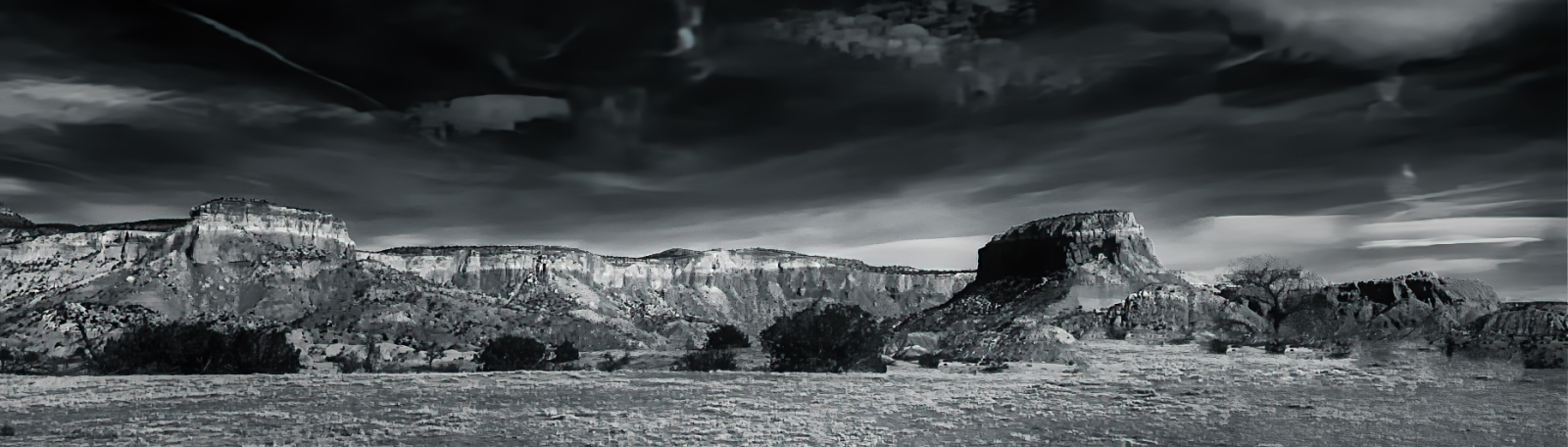
Moving into New Mexico, we arrive at the “Ghost Ranch” near Abiqui. The Ghost Ranch is famous for (among other things) being the site of the ranch of Georgia O’Keeffe, the famous America painter who created many works based on the landscapes and flora of the region. I have many photographs of the Ghost Ranch, Abiqui, and the surrounding area, but I think the following panorama best captures essential wildness of the place.

The ranch at the Ghost Ranch is today a conference center. The introduction to the conference center reads: “Dinosaurs once walked the soggy wetlands that became the arid high desert of Ghost Ranch. Millions of years later Navajos and various other tribes roamed the valley. The Spaniards settled here and then came the cattle rustlers, the wranglers and the dudes…. When the cattle rustlers were hiding their stolen goods in the box canyon alongside Kitchen Mesa, they discouraged their neighbors from looking around by spreading the rumor that the land was haunted by evil spirits. “Rancho de los Brujos” it was called, “Ranch of the Witches,” which naturally evolved into Ghost Ranch.”
Over to eastern New Mexico, The Pecos River rises in the Sangre de Christo mountains, and flows generally south until it meets up with the Rio Grande shortly before reaching the Gulf of Mexico. I titled the image, “Clouds Over the Pecos.”

The Pecos has been officially designated in the US as a “wild and scenic river.” This is wild country. The Pecos was considered the gateway to the “Wild West.” “West of the Pecos” is a 1945 film starring Robert Mitchum and Barbara Hale. It was based on a novel by Zane Grey, chronicler of the old west.Texas and New Mexico squabbled over the Pecos water rights until 1949.
Moving on, we arrive at central New Mexico, near Scottsdale and Phoenix, south of which begins the Sonoran Desert. I think ofthe Sonoran Desert as pretty wild. The ecology of the desert is unique while it is home to many distinctive and unique varieties of plants and a varied animal population. It is the only place in the world where the Saguaro Cactus grows in the wild.

That’s seven, which is the suggested limit for the number of images. I’m very partial to the American southwest, so that’s were I’ve drawn all these images from.
If you’re interested in the Lens-Artists Challenge and would like more information, go here. Egidio posted this week’s challenge. Next week’s challenge will come from Ann-Christine. It will go live at noon EST in the USA.


Leave a Reply