This is Joanne, from Joanne Mason Photography, and I’m honored to be your guest host this week. This is Lens Artists Challenge #367: Everyone Should See This.
Often times we see something that inspires us. We think – “Oh! I wish others could see this!” It might be a place, a thing, people maybe, that you think everyone should see. Maybe it’s something you’ve discovered. Or it’s a special place you’ve been to that you think is definitely worth sharing. Or perhaps it’s a person (or people) that you know or have met that you think others should know about. I think all of us have this experience now and again. And most of the time, we take a picture of it. Maybe it’s the picture itself – an image that represented a challenge, something you’re especially proud of.
This week’s challenge is to share some photographs of things/people/places that are inspiring and that you want to share. Tell us the circumstances of your photograph and why you want everyone to see it.

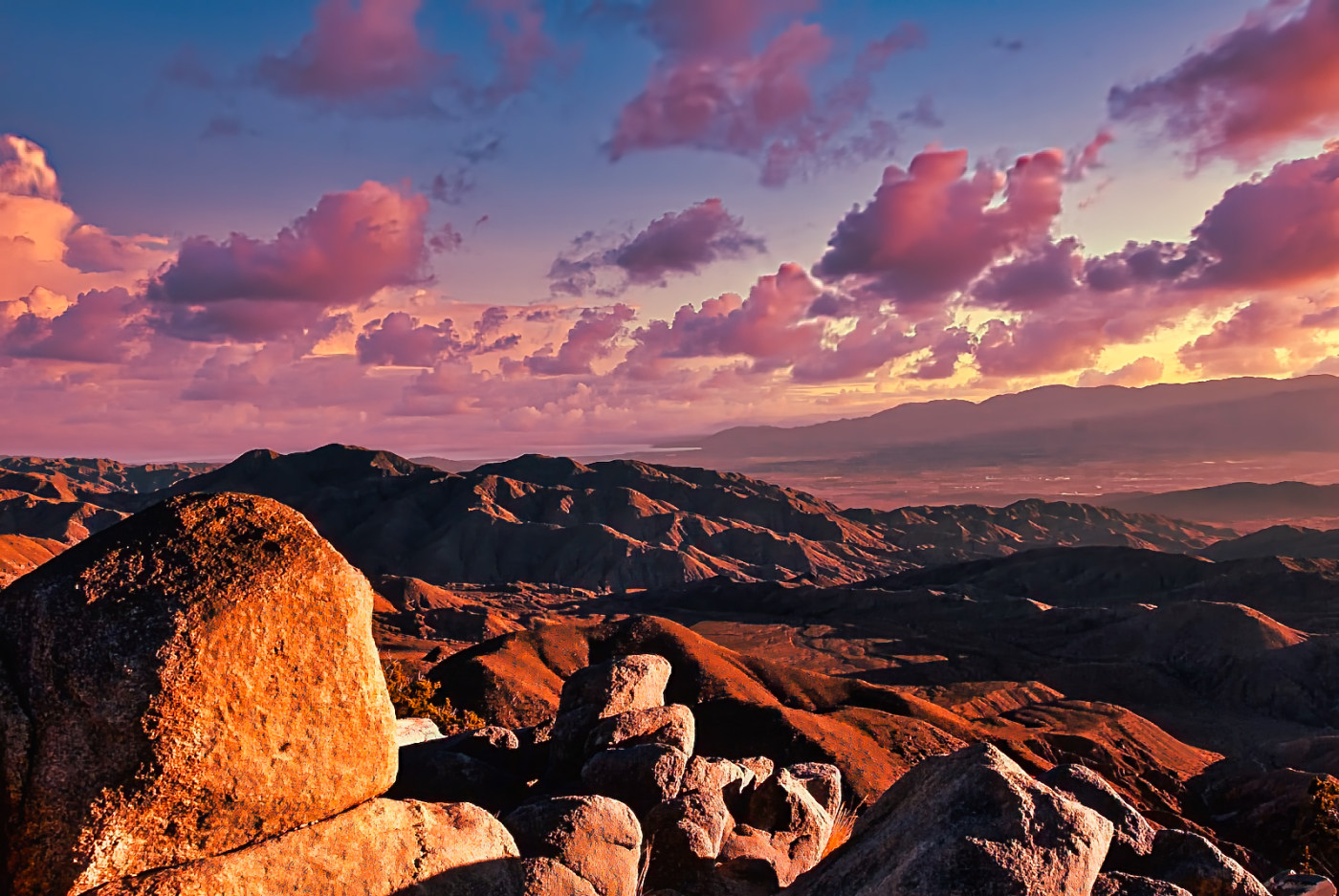
This, the featured image above and to the left, is one of my most favorite landscapes. It’s the vista from Keys View in Joshua Tree National Park, Southern California. An extraordinary spot – At over 5,000 feet, Keys View is the highest point in Joshua Tree. As in this image, it’s a popular spot for watching spectacular sunsets.
From Keys View we can see the entire Coachella Valley, from Palm Springs on down. We can see the Famous San Andreas Fault snaking its way across the valley. In the distance, we see the inland Salton Sea, and beyond, Mexico.
Keys View is named for Bill Keys, an early settler, and one of the most colorful and significant characters in Joshua Tree. Keys built a ranch (1910), which included a home, a gold mine, a hotel, and a school.
There are other reasons to visit Joshua Tree National Park. The park straddles the junction of two deserts, the high Mojave Desert and the low Colorado Desert. Joshua Tree National Park is home to mountains and incredible boulder and rock formations and to the ubiquitous Joshua Tree. (Although the Joshua Tree is endemic to Joshua Tree N.P., it is also found in the higher elevations of the Mojave Desert.)
The Mojave Desert in Joshua Tree N.P. has been home to human settlement for 5,000 years. The tree is thought to have been named by early Mormon settlers who believed its shape represented Joshua leading them in their journeys to find new homes. Everyone should see this.


Perhaps what you want to share with everyone is not just the subject of a photograph but the photograph itself. It will be an image that you’re really proud of, whether because of the subject or the technique.
This is the New York City skyline shot (with a very long lens) from Tod’s Point, in Greenwich, CT, on the Long Island Sound.

One can see the Freedom Tower, which replaced the Twin Towers brought down by the 9/11 attacks; the Empire State Building; and, to the far right, the first of the “super-tall” residential towers rising around 57th Street. The distance from Tod’s Point to mid-Manhattan is approximately 29 miles. I also edited the image to produce what I thought would be an interesting texture.
Do you have a photograph (or several) that you want to “show off”?
To me, the greatest of all flowers are the orchids. Almost all orchids feature spectacular blooms. They are found everywhere around the world except Antarctica. The orchids comprise one of the largest families of flowering plants, with almost 30,000 species. Here is a selection of orchids. (Click for larger images.)


Not included in this gallery are the “Ladyslipper” orchids (Cypripedium) – Because I have not photographed any in nature. They are becoming increasingly rare, mainly due to over-collection and disappearing habitat. In nature, ladyslippers are perennials. At home, the culture of ladyslippers can be demanding. Growing most orchids can be challenging.
If you have photographs of ladyslippers in nature, feel free to post them. Indeed, in the spirit of this week’s challenge, perhaps you have photographs of other rare flowers. Don’t hesitate to share them.
The following image is of Spider Rock in Canyon de Chelly (Pronounced “Shay”) in Northeastern Arizona.

Spider Rock is an 800-foot-tall rock formation in Canyon de Chelly, in lands of the Navajo Nation. In a unique partnership, this national park is managed by the Park Service but owned by the Navajo. Spider Rock was created over 200 million years ago. The canyon walls exhibit the remains of cliff dwellers and ancestral Pueblo people from whom the Navajo are descended, making Canyon de Chelly one of the longest inhabited areas in North America
Spider Rock is significant in Navajo creation stories. Spider Mother resides on the taller spire, overseeing and protecting the Navajo people. Spider Mother wove the universe and taught the Navajo the art of weaving, beauty, and balance among mind, body, and soul.
It is awe-inspiring to me that this geologic site is over 200 million years old; that humans have lived here for 4,000 years; and that it is the source of history and culture for people of the Navajo Nation, who have contributed much to the history and culture of the United States.
Perhaps you’ve seen and photographed something unique, something that tickles your funny bone. If it’s even a little bit unusual, it’s worth sharing.


Stamford, Connecticut, invites local artists to paint and decorate cast statues of pigs, which are then displayed at intersections throughout downtown Stamford. It’s a nice bit of summer whimsy for strollers to enjoy. If you have anything unique and whimsical like this, feel free to share.
The entire 695 miles of Route 1, along California’s Pacific coast from Santa Monica in the south to the Oregon Border, is one of the world’s loveliest and most enjoyable drives. The 90-mile stretch from San Simeon in the south to Carmel-by-the-Sea in the north is a region known as the Big Sur – a rugged and beautiful region unlike any other in the world. The Santa Lucia Mountains rise directly from the shoreline to heights of nearly a mile. Cone Peak, at 5,158 feet, is the steepest coastal elevation in the contiguous United States, peaking only three miles from the Pacific Ocean.
(Click for gallery with larger images.)


While the interior of the Big Sur is mostly uninhabited, the natural and rugged beauty of the coastal region has long attracted writers, poets, artists, and intellectuals (and movie stars). The American poet Robinson Jeffers lived in the Big Sur and wrote many poems celebrating its beauty.
Big Sur is famous for its rugged and awe-inspiring coastline with dramatic cliffs, rocky shores, and powerful ocean views; giant redwood forests; breathtaking views along Highway 1; the beauty of its beaches and waterfalls; and its rich history of attracting artists and writers. Everyone should drive California’s Coast Highway, and allow time to visit the Big Sur.
So that’s this week’s Lens Artist Challenge: Share with us photographs of places/people/things that you find uniquely inspiring – or photographs themselves that you are proud of – Simply stated, photographs everyone should see. It has been a honor for me to have been your guest host this week. I am eager to see your work.
Last week’s challenge was hosted by Tina who asked us to reflect on urban and rural scenes in City Mouse/Country Mouse. Next week, it will be John’s turn to challenge us. Watch for his post at his Journey’s With Johnbo.


Leave a Reply